- May Every Life Have Peace
- 929.348.4884
- 929.348.4885
- intake@stxavierhcs.com

OKX Spot Trading and Login: Myths, Mechanics, and What US Traders Should Know
Página Apuestas Deportivas Venezuela
December 11, 2025Mobilné Kasíno S Bonusom Za Vklad 10 Eur Pre Rok 2026
December 11, 2025Misconception: logging in to an exchange is a trivial step that only matters when you want to trade. Reality: the sign‑in process, account design, and security choices shape what you can do on the platform and how resilient your position is against theft, regulatory hurdles, and simple human error. For US-based traders preparing to use OKX for spot trading — buying and selling cryptocurrencies at market prices — the login is the gateway that determines access to staking, yield tools, DeFi bridges, and higher‑risk features like margin. Treat it like part of your trade infrastructure, not just an entry password.
This explainer walks through how OKX’s login and account model maps to spot trading needs, highlights concrete trade‑offs (convenience versus custody, liquidity versus delisting risk), and gives decision‑useful guidance: when to use the custodial exchange, when to move assets into the Web3 wallet, and what to watch that could disrupt your trading workflow in the near term.
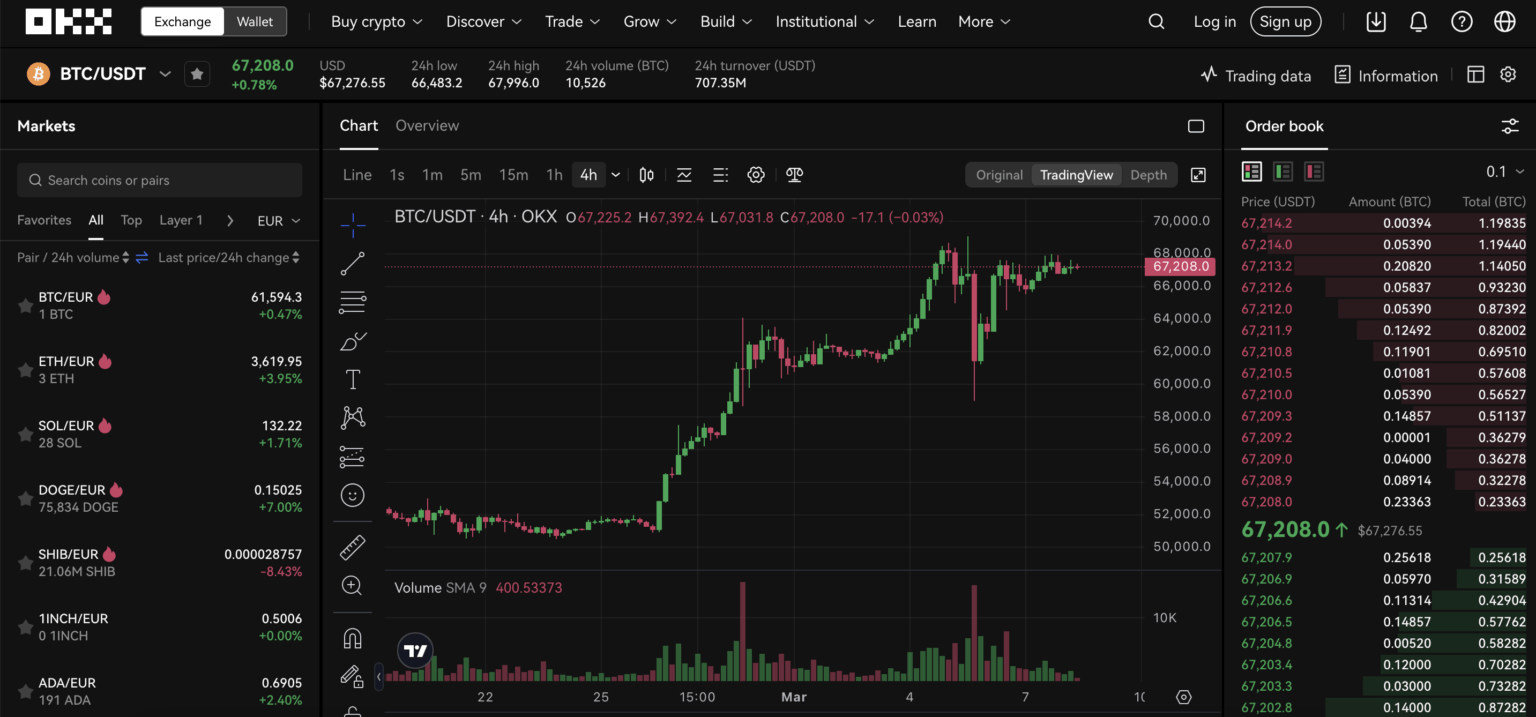
How OKX Sign‑In Works and Why the Details Matter
When you sign in to OKX you’re interacting with two overlapping systems: a centralized account controlled by the exchange and an optional non‑custodial Web3 wallet you can attach. The central account gives you spot trading, custody of deposited funds, staking and access to centralized features. The Web3 wallet hands you private keys and direct DeFi access. That distinction matters because custody determines who bears operational and counterparty risk.
OKX uses strong protections: military‑grade encryption, AI‑driven threat detection, and mandatory two‑factor authentication (2FA) using SMS, an authenticator app, or biometric options on mobile. These controls reduce account takeover risks but do not eliminate them. Phishing remains the most common attack vector, and your own choices — reusing passwords, storing 2FA backups insecurely, or clicking a fraudulent link — are still the weak link. For US traders, where account freezes and regulatory KYC are common, expect identity verification (KYC) to be part of the sign‑up path: government ID plus a liveness check.
For a direct resource to the exchange sign‑in page and steps, visit this official helper for OKX sign in: okx login.
Spot Trading Mechanics: Orders, Liquidity, and Where It Breaks
Spot trading on OKX is straightforward in principle: you place market or limit orders to buy or sell at prevailing prices. Mechanically, the exchange matches orders against order books and liquidity pools aggregated across pairs. But the performance you experience depends on three interacting factors: pair liquidity, market volatility, and the exchange’s internal rules (fees, minimum order sizes, and any temporary limits after delistings or maintenance).
Liquidity makes or breaks executions. For major pairs like BTC/USD or ETH/USDT, spreads are tight and slippage is low. For thin or recently delisted tokens, spreads widen and your market order can move price dramatically. OKX recently delisted several spot pairs (RSS3, MemeFi, GHST, RIO, SWEAT) as part of routine maintenance; this is a reminder that exchanges prune low‑volume listings to protect market quality. If you trade small‑cap assets, expect occasional delistings and monitor announcement feeds; delistings can force urgent withdrawals or conversions prior to a deadline.
Another operational boundary: slippage and latency. Fast price volatility — typical around major macro events or large token movements — can turn a market order into a regrettable execution. Use limit orders for price certainty; use market orders only when immediacy is worth the execution risk. If you plan to trade during US market hours that coincide with crypto movers, be explicit about acceptable slippage and use post‑only or fill‑or‑kill options when available.
Custodial vs Non‑Custodial: Choosing Where to Keep Assets
OKX keeps over 95% of custodial user funds offline in air‑gapped cold wallets using multi‑signature approvals. That architecture reduces the chance of a single breach draining the platform. The exchange also publishes Proof of Reserves so users can verify on‑chain backing. Those points are meaningful: they lower systemic counterparty risk relative to lesser‑resourced platforms.
Yet custody is a trade‑off. Holding assets on OKX gives you immediate access for spot trading, staking, and margin, and spares you from managing private keys. If you self‑custody in OKX’s Web3 wallet, you keep the keys and avoid counterparty risk — but you take on personal custody risks: lost seed phrases, hardware failure, or social engineering. Smart traders segment funds: leave a working balance for spot and quick opportunities on the exchange, and keep long‑term holdings in a self‑custodial wallet (preferably with a hardware key like Ledger/Trezor). That split reduces both execution friction and exposure to exchange policy risks such as emergency withdrawal freezes.
Practical Trade‑Offs for US Traders
Regulatory and operational realities in the US add a layer of friction. Expect robust KYC and occasional document re‑checks. Plan for delays: identity verification can take hours to days depending on volume and the exact documents submitted. Don’t assume instant trading access the moment you create an account — fund transfers (ACH, wire) also have bank processing times.
Margin and derivatives require extra care: OKX allows up to 10x leverage on margin (spot margin mode) and up to 125x on some derivatives, but when price volatility spikes, liquidations can cascade very quickly. If you primarily want spot exposure to reduce liquidation risk, focus on spot and staking products rather than borrowed positions. Staking on OKX includes flexible and fixed‑term options plus auto‑compounding; these can be a sensible low‑maintenance yield source but read lockup terms and unstaking penalties carefully.
One Useful Heuristic: The Three‑Tier Decision Framework
When you sign in and decide what to do with funds, apply a simple framework: Intent, Time horizon, and Risk control.
– Intent: Are you trading intraday, accumulating for long term, or staking for yield? Immediate trading needs favor custodial balances; accumulation favors self‑custody or cold storage.
– Time horizon: Short horizon + high liquidity requirement → keep funds on OKX. Long horizon → move to Web3 wallet or cold storage.
– Risk control: For any funds on the exchange, enforce strong 2FA, whitelist withdrawal addresses where possible, and keep only a working balance. For non‑custodial holdings, use hardware wallets and multi‑party backups.
FAQ
Q: If OKX delists a spot pair I hold, what happens to my funds?
A: The exchange typically announces a delisting window and disables new trading on that pair, giving holders time to withdraw or convert. If you miss the window, the exchange may force conversion into a base asset or close the position — read announcements closely and act before the deadline. Delisting is a liquidity and compliance management tool, not necessarily a sign of fraud, but it does create operational risk.
Q: Is the OKX Web3 wallet safer than keeping funds on the exchange?
A: Safer in the sense that you remove counterparty risk — the exchange can’t freeze your keys. Less safe if you don’t secure the seed phrase. There’s no free lunch: custody transfers risk from the platform to the individual. Use hardware wallets and tested backup procedures if you choose self‑custody.
Q: How should I set up login protections as a US trader?
A: Use a unique, strong password; enable 2FA via an authenticator app (avoid SMS if possible); enable device and withdrawal whitelisting; and consider hardware security modules for high‑value accounts. Keep KYC documents ready and use email filtering to reduce phishing exposure.
Q: Can I stake assets I hold on OKX after logging in?
A: Yes. OKX supports flexible staking, fixed‑term lockups, and DeFi yield farming with some auto‑compounding options. Before staking, check lockup duration, early‑withdrawal penalties, and whether the staking vehicle exposes you to smart contract risk if the reward is sourced from DeFi protocols.
Where this becomes crucial is not in a single login moment but in the pattern you build. A secure, intentional login process reduces the chance of a stolen session, a hurried trade, or an irreversible custody mistake. For US traders balancing fast access with regulatory friction, the sensible path is explicit: maintain a small, actively traded exchange balance; keep larger, long‑term positions in self‑custody or cold storage; and treat sign‑in hygiene as part of your portfolio risk management toolkit.
What to watch next: monitor OKX announcements for routine delistings and maintenance windows, watch Proof‑of‑Reserves updates if you care about backing transparency, and track any shifts in US regulatory guidance that could affect KYC or withdrawal processes. These signals change operational friction more than the underlying mechanics of placing a spot order — but they change the cost of being wrong.
